








How do you choose a thermometer?
If your application requires accurate and stable temperature measurement while ensuring the safety of both equipment and operators, selecting the right dial thermometer is essential. Choosing the wrong instrument may result in gauge damage, inaccurate readings, or even equipment downtime that can disrupt overall operations.So, how can you determine whether you’ve selected the most suitable dial thermometer? In this article, SJ Gauge will share several important selection considerations and walk you through six key factors you should not overlook when choosing a dial thermometer.
If you have any further questions about dial thermometers, feel free to contact SJ Gauge at any time. Our professional team will recommend the most suitable temperature measurement solution based on your application needs, helping you simplify the selection process and ensure stable equipment operation.
1. Dial Size of Dial Thermometers
How can you choose an appropriate size for a thermometer dial?
When selecting a thermometer dial size, the viewing distance and available installation space should be your top considerations. In general, the farther the distance between the thermometer and the observer, the larger the dial should be to improve readability and make monitoring easier. At the same time, it is important to ensure there is sufficient installation space to avoid fitting issues or inaccurate readings caused by an oversized dial. Below are the common thermometer dial sizes offered by SJ Gauge.
- 1″ (25mm)
- 1 ½” (40mm)
- 2″ (50mm)
- 2 ½” (63mm)
- 3″ (75mm)
- 4″ (100mm)
- 6″(150mm)

2. Scale Range of Dial Thermometers (Measuring Range)
How can you determine the appropriate temperature range?
When selecting a thermometer, the temperature scale should be based on your actual operating temperature range. It is recommended that the normal operating temperature falls within approximately two-thirds of the full scale range to ensure clear readability and maintain measurement accuracy. Choosing an incorrect temperature range may result in poor readability, increased measurement errors, or even shorten the service life of the instrument. For example, if your normal operating temperature ranges from +10°C to +90°C, a thermometer with a scale range of 0°C to +100°C would be recommended. SJ Gauge also provides common temperature ranges based on the BS EN 13190 standard, as shown in the table below.
| Thermometer Dial Range (Unit: °C) | Common Temperature Range (Unit: °C) |
| -20 … +40 -20 … +60 -20 … +120 | -10 … +30 -10 … +50 -10 … +110 |
| -30 … +30 -30 … +50 -30 … +70 | -20 … +20 -20 … +40 -20 … +60 |
| -40 … +40 -40 … +60 -100 … +60 | -30 … +30 -30 … +50 -80 … +40 |
| 0 … 60 0 … 80 0 … 100 | 10 … 50 10 … 70 10 … 90 |
| 0 … 120 0 … 160 0 … 200 | 10 … 110 20 … 140 30 … 180 |
| 0 … 250 0 … 300 0 … 400 | 30 … 220 30 … 270 50 … 350 |
| 0 … 500 0 … 600 0 … 700 | 50 … 450 100 … 500 100 … 600 |
| 50 … 650 100 … 700 | 150 … 550 200 … 600 |
In addition to dial size and temperature range, different applications may require different temperature scale ranges. When confirming specifications with your instrument supplier, it is recommended to select a range with an upper limit that closely matches your actual maximum operating temperature. If your operating temperature exceeds the standard range, the next higher range should be selected.
Choosing an incorrect temperature range may affect measurement performance. A range that is too large can reduce reading accuracy and readability, while a range that is too small may lead to over-temperature conditions, instrument damage, or even dial failure. If you are unsure which temperature range is suitable for your application, feel free to contact SJ Gauge for professional temperature measurement solutions.
3. Connection Location of Dial Thermometers
What mounting types are available for thermometers, and how do you choose the right one for your application?
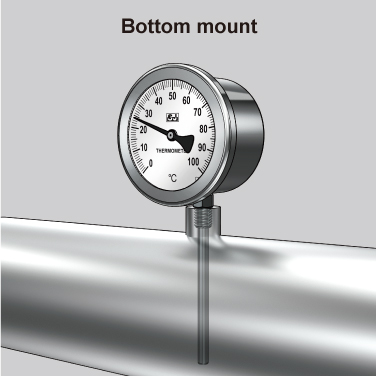
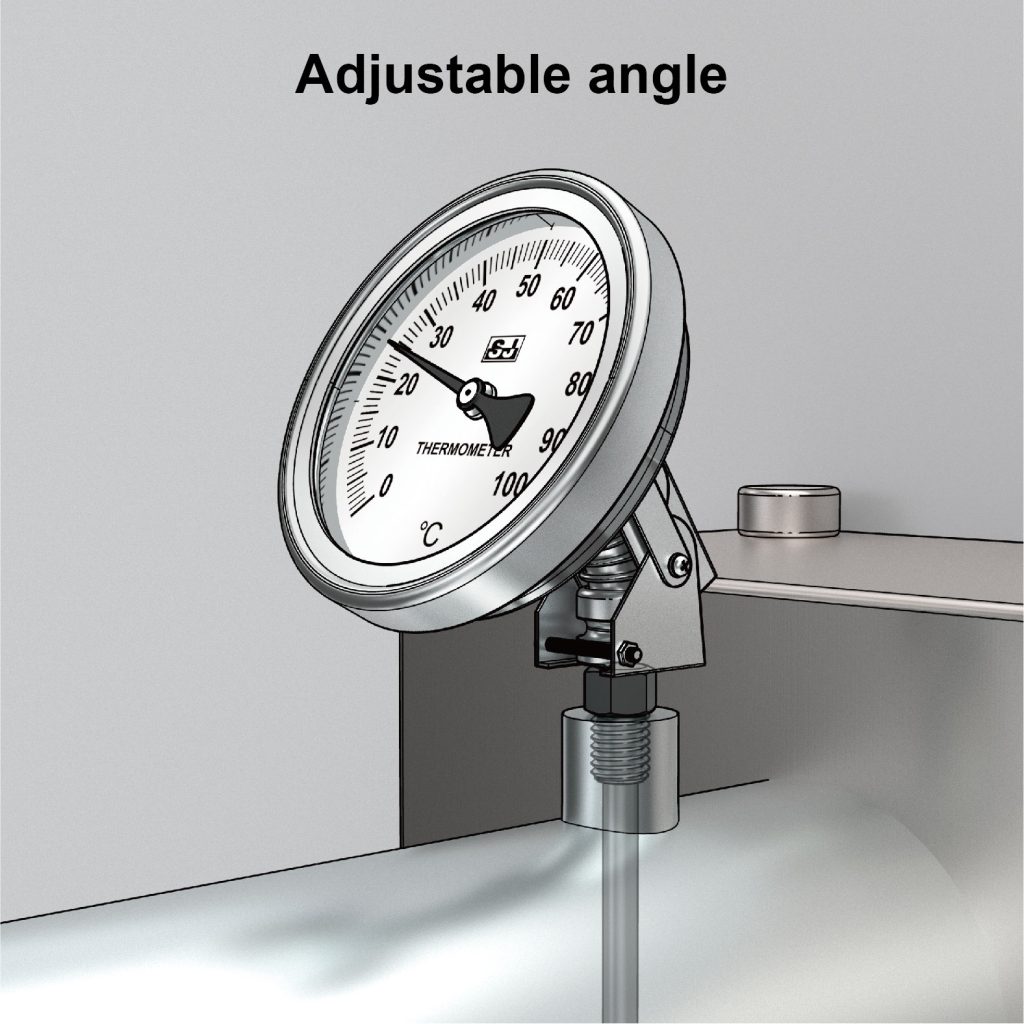
Dial thermometers are typically classified based on their mounting style and connection position. The three most common types include Bottom Entry, Adjustable Angle (Every Angle), and Back Connection thermometers. Back connection models can also be further divided into Flanged and Non-flanged types, depending on whether a mounting flange is required. For more specialized mounting designs, please refer to the BS EN 13190 standard.


4. Process Connection of Dial Thermometers
How do you choose the right thermometer connection size?
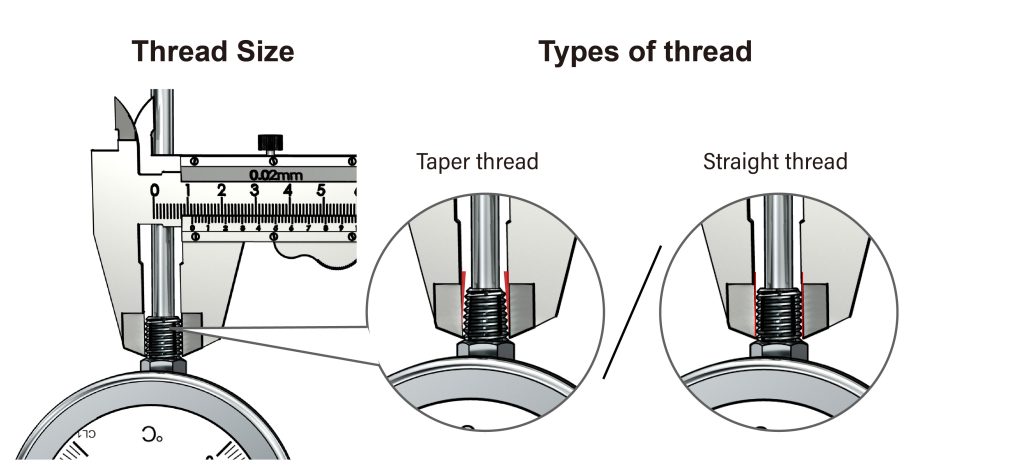
You can refer to our previous guide on common thread specifications and selection tips. To identify the thread size of a dial thermometer, you can measure the outer diameter of the connection using a caliper. Thread types are generally divided into parallel threads and taper threads. In Europe and many international industrial applications, BSP threads are commonly used, while NPT threads are more common in North America.
5. Stem of Dial Thermometers (Thermal Probe)
What is a thermometer stem, and what is its function?
The stem is the sensing element of a thermometer, responsible for detecting temperature. It is typically constructed with a bimetal element and designed as a rod-shaped probe that measures temperature through direct or indirect contact with the process medium. Common materials include 304 stainless steel and 316 stainless steel, with a standard stem diameter of approximately 6.35 mm, while custom specifications are also available.
How do you select the appropriate stem length?
The required length depends on the medium or container being measured. For optimal measurement performance and accuracy, it is recommended that the stem be fully immersed in the medium, or at least inserted to a depth of approximately 1/3 to 2/3 of the total length.
Therefore, when placing an order or requesting a quotation, it is important to confirm the actual depth of the tank or pipeline with the supplier (note: the minimum stem length is typically around 50 mm) and clearly specify whether the required length includes the thread (with connection) or excludes the thread (without connection).

6. Thermowells and Protection tubes
What are protection tubes and thermowells, and what is the difference between them?
These accessories are typically purchased separately and are designed to protect the thermometer stem from corrosion, high-pressure environments, and physical impact. They also allow the thermometer to be removed for cleaning, maintenance, or replacement without shutting down the system. The main difference lies in their construction: a protection tube is usually made from hollow tubing with a welded closed tip, while a thermowell is machined from solid bar stock, offering higher durability but at a higher cost.
What should you consider when using a protection tube or thermowell?
Since these components create a barrier between the thermometer stem and the process media, they may increase response time. In addition, the type of media, flow rate, and heat transfer efficiency can all affect how quickly temperature is transferred to the sensing element.
What are the common specifications for protection tubes and thermowells?
Common materials include 304 stainless steel and 316 stainless steel. For highly corrosive environments, materials such as Hastelloy and Monel may also be used. Coating or plating options may be available depending on the application. Common thermowell designs include closed-end and solid types, with shape options such as tapered, straight, and stepped designs. Different connection options, including threaded and flanged connections, are also available.

Further Information
In addition to the six key factors for selecting a dial thermometer covered in this article, it is also important to consider product calibration, accuracy testing, and pre-shipment quality inspection when choosing the right thermometer. As a trusted instrumentation supplier in Taiwan, SJ Gauge provides pre-delivery calibration, performance testing, and quality inspection reports to ensure every product meets high-quality standards and your specific application requirements.
With over 20 years of professional measurement experience, SJ Gauge is committed to providing customized temperature measurement solutions to simplify your selection process. From specification selection and component assembly to calibration and ongoing maintenance support, we are dedicated to delivering reliable products and professional service. Contact SJ Gauge today to find the right temperature measurement solution for your business needs.
After reading this guide, you should now have a better understanding of how to choose the right dial thermometer. Want to learn more about proper installation, maintenance tips, and the factors that may affect temperature measurement accuracy? Click the links below to explore more helpful resources.