







- Integrally formed without any seams to avoid leakage effectively
- Vent valve and blow-out device (plug) for improved safety
- Used in the petrochemical industry, power engineering, and sewage treatment
- Same specifications as WIKA-232.50/233.50


Pressure Gauges
Pressure Gauges FAQ
Common selection questions for mechanical pressure gauges, low pressure gauges, process gauges, and safety gauges.
How do I choose a mechanical pressure gauge?
Start with the pressure range, media type, connection thread, mounting direction, case material, wetted material, accuracy, and operating environment. For harsh environments, stainless steel cases, liquid filling, safety cases, or diaphragm seals may be required.
When should I use a low pressure gauge?
Low pressure gauges are used for small pressure ranges such as gas, air, ventilation, filter, and low-pressure process applications. Capsule or diaphragm-type measuring systems are usually selected when a standard Bourdon tube gauge is not sensitive enough.
What is the difference between stainless steel and copper alloy wetted parts?
Copper alloy wetted parts are suitable for many non-corrosive gases or liquids, while stainless steel is preferred for more demanding, corrosive, humid, or industrial environments. The final choice should match the process media and temperature.
When should a pressure gauge include a diaphragm seal or accessory?
Add a diaphragm seal for corrosive, viscous, crystallizing, high-temperature, or sanitary media. Add a siphon for steam, a snubber for pulsation, and an overpressure protector when pressure spikes may exceed the gauge range.
Showing all 12 results
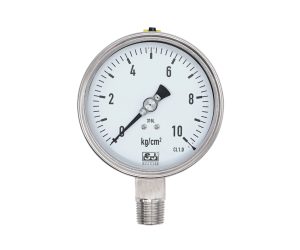 Model: PRDR.W
Stainless Steel Pressure Gauge, Laser Welding
 Model: PRS
Stainless Steel Pressure Gauge, Stainless Steel Case
- For liquid or gaseous pressure media that will not attack copper alloy parts
- Prepared for liquid filling for applications with high dynamic pressure loads or vibrations
- Suitable for pumps, compressors, hydraulics or other indoor and outdoor applications
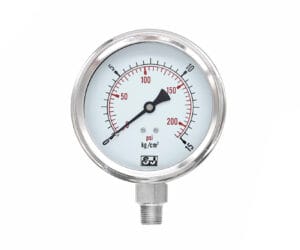 Model: PRSS
Stainless Steel Pressure Gauge, Stainless Steel
- For gaseous and liquid pressure media that are not highly viscous or crystallizing
- Liquid-filled type available to avoid hard observation from pointer vibration
- Ideal for food and beverage, or other process engineering industries
 Model: PRHP
Stainless Steel Pressure Gauge, Ultra High Pressure
- Suitable for high-pressure liquids, for instance: water, hydraulic oil, etc.
- Typically found with equipment for water jet cutting, extremely high-pressure cleaning and bench testing (e.g. for hydraulic components)
 Model: PRSF
Stainless Steel Pressure Gauge with Solid Baffle Wall, Safety
- A solid baffle wall between the measuring system and front dial to protect the operator
- When experiencing failure, the case is equipped with a blow-out back to eject dangerous media out the back of the case safely
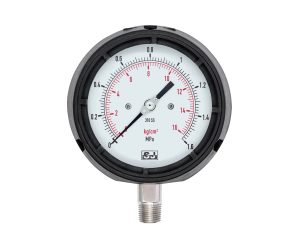 Model: PRPC
Stainless Steel Pressure Gauge with Phenolic Case, Process Industry
- The phenolic case is resistant to heat and high acid and also provides good insulation
- Solid barrier on the front and pressure relief system on the back for safer measuring
 Model: PRST
Stainless Steel Pressure Gauge, High Temperature / Boiler
- Copper alloy or 304 stainless steel wetted parts for high-temperature service
- Large dial design for remote reading in plants and industrial equipment
- Commonly used as a boiler pressure gauge or steam pressure gauge
 Model: PRM
Low Pressure Gauge, Iron case
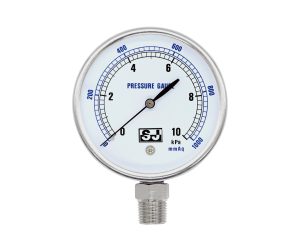 Model: PRSM
Low Pressure Gauge with Stainless Steel Case
 Model: PRSSM.TU
Low Pressure Gauge, Stainless Steel
- Can only be used to measure the pressure of non-liquid media
- For gaseous, dry and aggressive media, as well as adverse environments
- The liquid-filled case design is suitable for highly dynamic pressure loads and vibrations
 Model: PRSSM-LD
Low Pressure Gauge, Diaphragm
- Ideal for low-range pressure measurement in harsh, viscous, or crystallizing applications.
- Pressure connections include threaded and flange mounting options, or electric contacts
- Suitable for applications in the chemical, petrochemical, oil and gas industries as well as power engineering
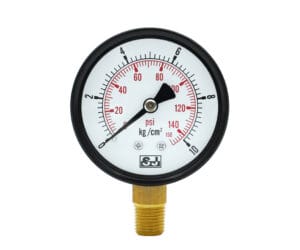 Model: PRI
General Industrial Pressure Gauge, Black Steel Case
- Compact 1.5″, 2″ and 2.5″ dial sizes
- Bottom or center-back mounting, with flange and U-clamp options
- Pressure ranges from 0 … 1 bar to 0 … 400 bar, plus vacuum and compound ranges
- Black zinc-plated steel case with copper-alloy wetted parts