








Summary: An “ANSI flange” is usually specified today by an ASME standard, nominal pipe size, pressure class, material, facing and dimensional pattern. Class 150 is a pressure-class designation—not a universal 150 psi working-pressure limit.
Industry still commonly says “ANSI flange,” but ASME B16.5 is the principal standard for pipe flanges and flanged fittings from NPS 1/2 through NPS 24. Large-diameter steel flanges are addressed by ASME B16.47. Always confirm the exact standard, edition, material group and project specification.
What Does ANSI Class 150 Mean?
Class 150 identifies one ASME pressure class. It does not mean that every Class 150 flange is limited to exactly 150 psi. Allowable pressure varies with material group and temperature according to the pressure-temperature rating tables in the governing standard.
A marking such as “ASME B16.5 NPS 2 Class 150 RF” identifies the standard, a 2-inch nominal pipe size, Class 150 and a raised-face connection. The material grade and other markings are still required to determine the complete specification.
How to Read an ASME Flange Specification
- Standard: confirm ASME B16.5, ASME B16.47 or the specified document and edition.
- Size: identify NPS and any DN reference on the drawing.
- Pressure class: identify Class 150, 300, 400, 600, 900, 1500 or 2500 as specified.
- Facing: confirm RF, FF, RTJ or another required facing.
- Material: verify the material specification, grade and pressure-temperature group.
- Dimensions: check outside diameter, bolt circle, bolt holes, thickness, bore and flange type.
Common ASME Pressure Classes
| Pressure class | How to interpret it | Selection note |
|---|---|---|
| Class 150 | Common general industrial class | Not equal to a universal 150 psi limit. |
| Class 300 / 600 | Higher pressure-class series | Dimensions and pressure-temperature ratings differ from Class 150. |
| Class 900 / 1500 / 2500 | High-pressure series | Requires exact material, temperature, bolting and design verification. |
This table explains the class names only; it is not a pressure rating chart. Use the official ASME pressure-temperature tables and the project design basis for final selection.
Common Flange Facings: RF, FF and RTJ
- RF — Raised Face: a raised gasket-contact area commonly used in industrial piping.
- FF — Flat Face: a full flat contact surface, often selected for certain cast-iron or low-stress connections.
- RTJ — Ring-Type Joint: a machined groove for a metal ring gasket, generally used in demanding high-pressure or high-temperature service.
Facing selection must match the mating flange and gasket design. Do not bolt incompatible facings together without an approved engineering design.
ASME Flanges for Pressure Gauges and Diaphragm Seals
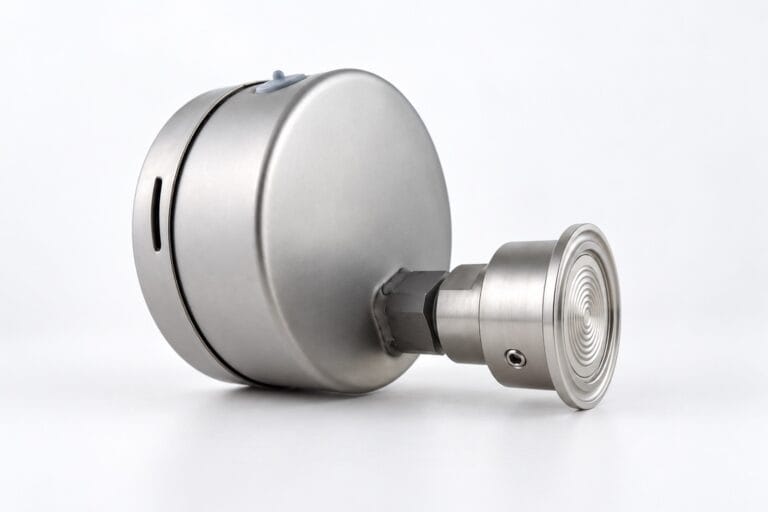
For a flanged pressure gauge or transmitter, the flange class is only one part of the selection. Confirm the measuring range, effective diaphragm diameter, fill fluid, wetted materials, process temperature, capillary length, flushing connections and installation orientation.
Low-pressure measurement often needs a larger diaphragm area. Corrosive, viscous, crystallizing or sanitary media may require special alloys, coatings, linings or extended diaphragm designs.
ASME, JIS and DIN/EN Flanges Are Not Automatically Interchangeable
ASME uses pressure classes, JIS commonly uses K classes, and DIN/EN uses PN designations. Similar nominal sizes do not guarantee matching outside diameters, bolt patterns, facings or pressure-temperature ratings. Compare approved drawings before using any adapter.
ASME Flange Selection Checklist
- Exact standard, edition and flange type
- NPS or DN reference and pressure class
- Facing and gasket design
- Material grade and corrosion compatibility
- Design pressure, design temperature and pressure spikes
- Bolt pattern, bolting material and approved drawing
- Instrument range, diaphragm size and installation arrangement
Frequently Asked Questions
Does ANSI Class 150 mean 150 psi?
No. Class 150 is a class designation. The allowable pressure depends on material and temperature. Use the applicable ASME pressure-temperature table.
Are ANSI and ASME flange standards the same?
“ANSI flange” is still a common market term, but current flange requirements are generally referenced through ASME standards such as B16.5 and B16.47. Confirm the exact document on the project specification.
Can a Class 150 flange connect directly to a JIS 10K flange?
Do not assume so. Dimensions, bolt patterns, facing and ratings can differ. Compare approved drawings and use a properly designed adapter when required.
Conclusion
To specify an ANSI/ASME flange correctly, identify the standard, size, pressure class, facing, material and service conditions as a complete set. SJ Gauge can review flange drawings and recommend a compatible pressure gauge, diaphragm seal or remote-seal arrangement.
Need help checking an ASME flange or selecting an instrument? Contact SJ Gauge with the flange marking, drawing, process fluid, pressure and temperature.
Standards reference
Refer to the current editions of ASME B16.5 and ASME B16.47, plus the project specification. Purchase the official standards when complete requirements or rating tables are needed.