

How deep should an industrial thermometer stem be inserted? There is no single length that works for every pipe or vessel. The active sensing section must reach a representative part of the medium, while the stem or thermowell must withstand the process conditions.
Too little immersion allows the pipe wall and ambient environment to influence the reading. Excessive unsupported length can increase fluid forces, vibration and bending loads. A longer stem is therefore not automatically a better measurement.
Distinguish Stem Length from Effective Immersion
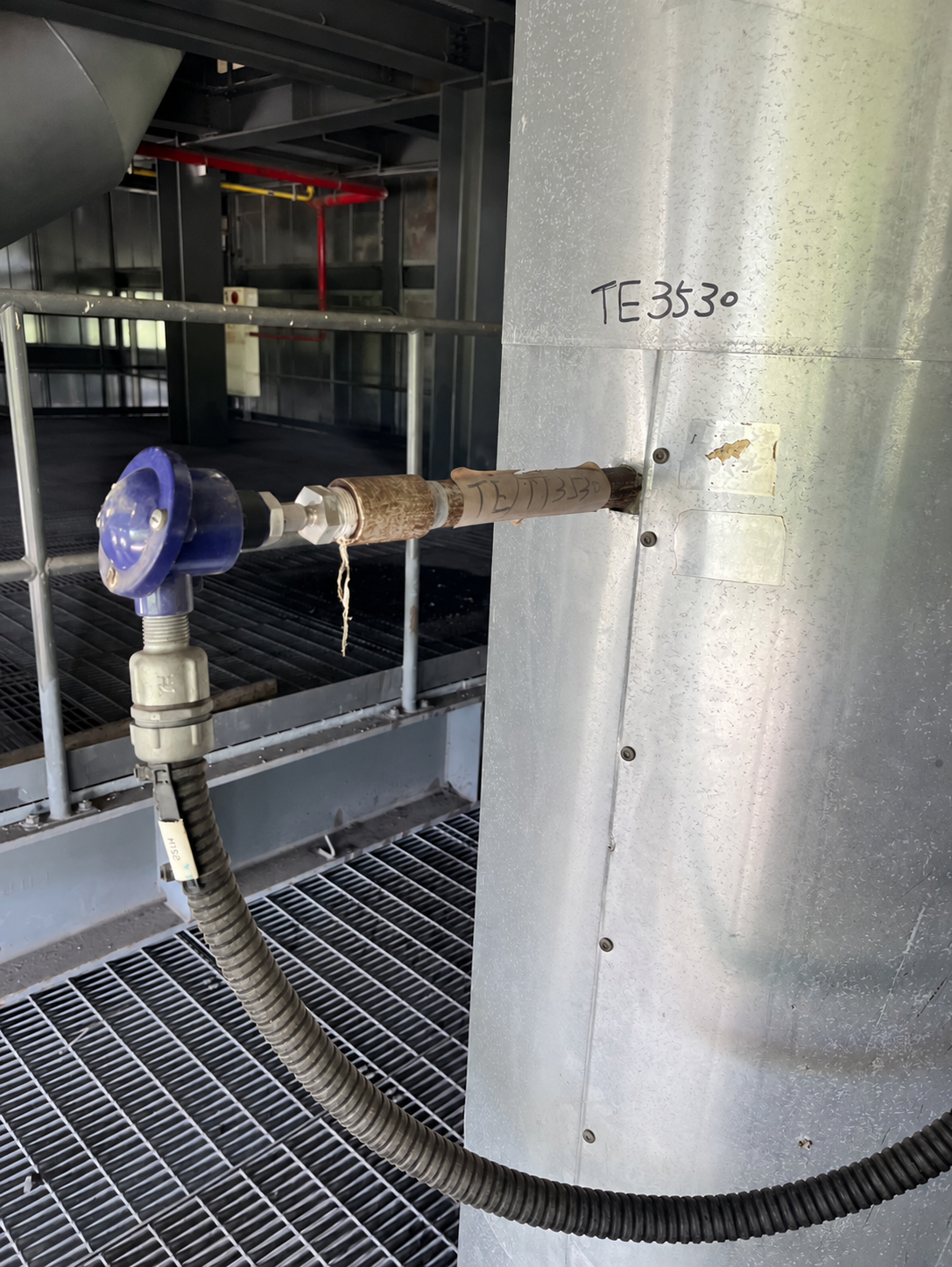
Check the reference point used on the manufacturer’s drawing. Overall stem length, the length below the process connection and actual immersion inside the pipe are different dimensions. The active sensing section is another specification and may occupy more than just the tip.
The nozzle, connection and insulation affect the installation geometry. Determine how much of the specified length lies outside the flowing medium, using a consistent reference point. Do not automatically subtract insulation thickness again if the drawing’s insertion dimension already excludes that external section.
When ordering a MTB.S_BA adjustable-angle bimetallic thermometer, confirm the stem length, active sensing length and process connection together. Adjusting the dial angle improves readability; it does not change how deeply the sensing section enters the medium.
What Happens When Immersion Is Too Shallow?
- The active sensing section may remain in the nozzle or near a low-flow region rather than the main stream.
- Heat conduction along the stem and pipe wall can pull the reading toward the surrounding temperature. A hot process in a cooler environment may then read low.
- A poorly coupled sensing section may respond differently to a temperature change, making the process trend harder to interpret.
Increasing immersion can reduce some installation errors, but first check whether the entire required sensing length is properly positioned. For broader installation checks, see Inaccurate Industrial Thermometer Readings: Check Installation.
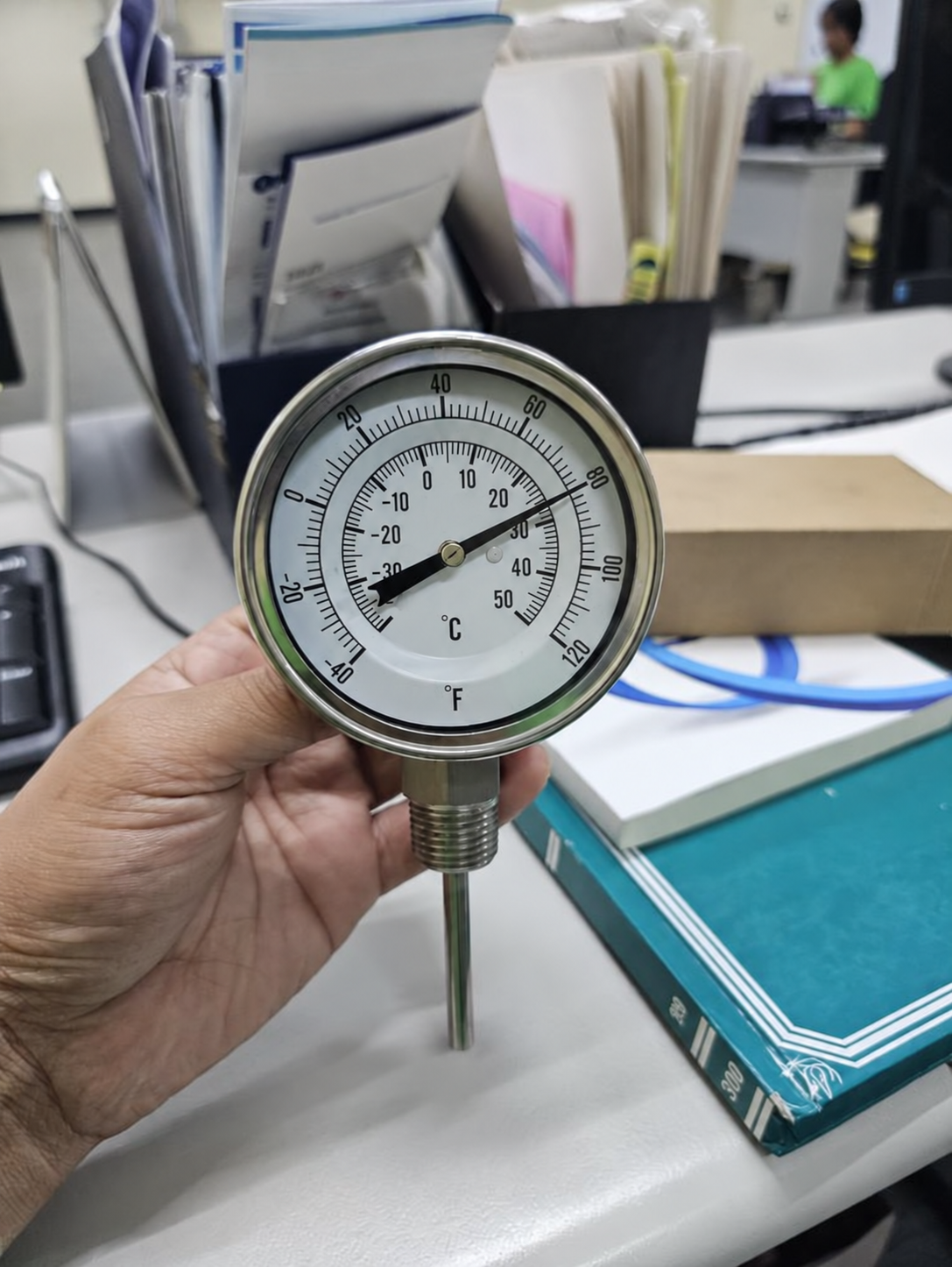
Can a Stem Be Inserted Too Deeply?
A stem or thermowell extending into moving fluid is exposed to drag and vibration. A longer unsupported section can be more vulnerable to bending or fatigue, especially at higher velocities. Temperature accuracy and mechanical suitability must therefore be assessed together.
In a small pipe, an angled connection or installation at a suitable elbow may provide more usable immersion, but the arrangement requires engineering review. Do not force the stem against the opposite pipe wall or assume that every installation must reach the centreline.
Match the Thermometer and Thermowell Dimensions
A thermowell separates the sensing stem from the process. Check its internal bore, usable internal depth, wall geometry and the manufacturer’s specified fit with the instrument. A stem that bottoms out before the connection seats correctly, or leaves an unintended tip gap, may not perform as expected.
For a threaded arrangement, the TWC threaded thermowell offers a starting point for discussing the required dimensions. Confirm the complete assembly for pressure, temperature, material and flow conditions; a catalogue length alone is not a mechanical approval.
Do not add heat-transfer compounds without checking compatibility and the instrument instructions. If response time is also a concern, review Slow Industrial Thermometer Response: Causes and Checks.
What Information Is Needed to Choose the Length?
- Pipe internal diameter or vessel dimensions, wall thickness and the intended measurement location.
- Nozzle height, connection dimensions, insulation thickness and a drawing showing the dimensional reference points.
- Medium type, normal and maximum temperature, pressure and flow velocity, including relevant transient conditions.
- Thermometer principle, stem diameter, active sensing length and required measurement response.
- Thermowell type, material, insertion length and any required vibration or strength assessment.
High-velocity, high-pressure or critical service may require a thermowell calculation within the applicable standard’s scope. Provide the full design data rather than choosing a length from a generic rule of thumb.
International Standards for Installation and Review
- ASME PTC 19.3-2024: guidance for temperature measurement, including instrument selection, installation, use and interpretation of results.
- EN 13190:2001: requirements and testing for industrial dial thermometers; its installation guidance is relevant when reviewing the sensing arrangement.
- ASME B40.200: addresses direct-reading and remote-reading thermometers, including construction, installation and general recommendations.
- ASME PTC 19.3 TW: a separate thermowell standard for mechanical evaluation within its stated scope. It should not be confused with PTC 19.3 temperature-measurement guidance.
Select the applicable edition and verification requirements for the project. These references do not establish a universal insertion depth or imply that a particular thermometer or thermowell is automatically certified.
Frequently Asked Questions
Is it enough for the sensing tip to pass the pipe wall?
Not necessarily. The active sensing section must reach a representative temperature zone and meet the manufacturer’s immersion requirement. Merely passing the inner wall may still leave it in a low-flow or thermally influenced region.
Can an overlong stem be cut shorter on site?
Do not shorten a dial thermometer stem unless the manufacturer explicitly specifies a design that allows it. The stem may contain a sensing element, transmission mechanism or a sealed filled system, and cutting it can permanently damage the instrument.
Confirm the Installation Drawing Before Ordering
Choose enough immersion for representative sensing while keeping the assembly mechanically suitable. Send the pipe size, nozzle height, insulation thickness, medium and flow data to SJ Gauge so the stem and thermowell dimensions can be reviewed together.